Posted April 24, 2026
A midwife's scope of practice is shaped by more than what is legally permitted. The four controls on practice determine what a midwife may perform in any given role and setting:
- Legislation and regulation
- BCCNM bylaws and standards (including limits and conditions)
- Place of practice policies and processes
- Individual midwife competence
Regulation may authorize an activity, but a midwife may perform it only when all four controls are met. Each control can narrow practice; none can expand practice beyond what is permitted by the level below.
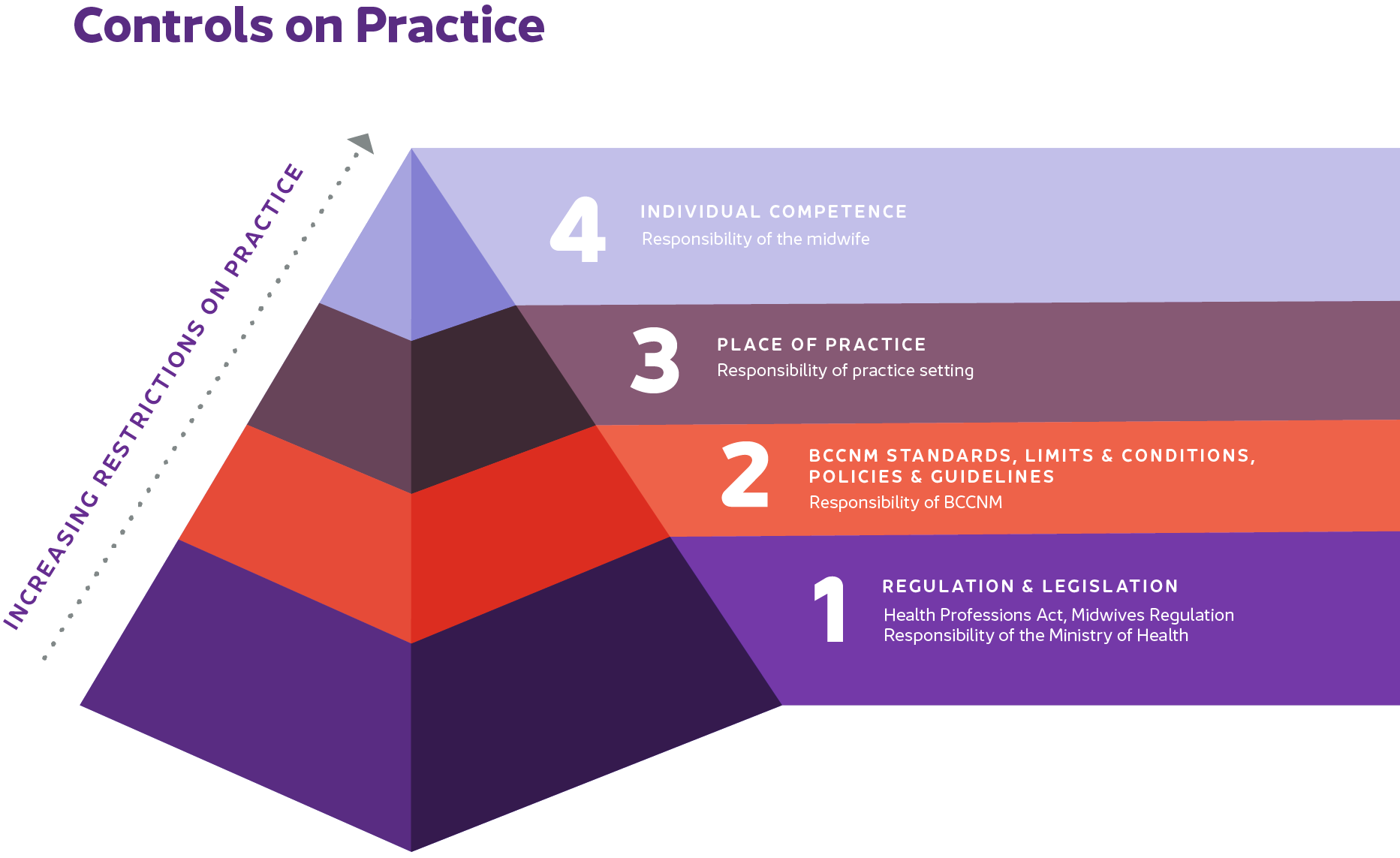
Level 1: Legislation and regulation
This level sets the legal foundation for midwifery practice in B.C. It establishes the profession's legislated scope of practice, and the restricted activities midwives may be authorized to perform.
- Health Professions and Occupations Act (HPOA)
- Nursing and Midwives Regulation (NMR), and the
- Regulated Health Practitioners Regulation (RHPR)
The legislated scope applies to all midwives across practice settings (e.g., hospital, community, or self-employment).
Example: A midwife providing intrapartum care in a hospital and a midwife attending a home birth work within the same legislated scope, but apply it differently based on setting, available resources, and client needs.
Level 2: BCCNM bylaws, standards, limits, & conditions
BCCNM sets ethics and practice standards, and may place limits or conditions on activities that are otherwise authorized in Regulation. Bylaws may also set additional requirements for practice.
Example: BCCNM may require additional education or other requirements before a midwife is authorized to perform certain activities (e.g., venipuncture), depending on the class of licensure and applicable requirements.
Level 3: Place of practice policies
A place of practice may set policies and procedures that specify how activities are performed and may restrict practice beyond Regulation or BCCNM standards. Job descriptions should clearly outline the responsibilities and expectations of a specific role.
If you are self-employed, you are also the employer. You are responsible for establishing appropriate policies, procedures, and supports to guide safe practice for yourself and any staff you employ.
Examples:
A hospital may authorize midwives to initiate IV therapy, but require site-specific training or verification of competence before a midwife performs advanced IV management (e.g., use of certain infusion devices).
In some settings, midwives may be supported to perform specific procedures on site (e.g., suturing, newborn screening, point-of-care testing), while in other settings the same procedures may require referral or transfer due to available resources or local processes.
A midwife may be legally authorized to perform an activity, but the place of practice may restrict it due to safety considerations, resource limitations, or organizational risk controls.
Level 4: Individual midwife competence
The first three controls define what a midwife may do. Competence determines what a midwife can safely do.
Competence is specific to the midwife and the context. It develops over time through education, experience, practice, and ongoing learning.
Example: A midwife with current competence and recent experience in a skill (e.g., suturing a second-degree perineal laceration or initiating IV therapy) may be able to perform it safely, while a newly licensed midwife may require additional education, mentorship, or practice support before performing the same activity independently.
Putting it together
The controls on practice help ensure every activity you perform is authorized, supported, and safe. A practical approach is to work through the levels in order:
- Is it permitted by legislation/regulation?
- Is it consistent with BCCNM standards, limits, and conditions?
- Is it supported/allowed in this setting?
- Am I competent to perform it safely for this client, today?
Finally, apply professional judgment: even when you can perform an activity, consider whether it is appropriate and, in the client's best interests.
Controls on Practice Framework in action
Scenario
Nancy (RM) is caring for a client in active labour at the local hospital. The client is having difficulty coping and asks for acupuncture for pain management. Nancy considers whether she is authorized to provide it.
Is Nancy is authorized?
Level 1 – Legislation and regulation
Nancy reviews the Regulation and confirms that midwives may insert acupuncture needles for pain relief during labour or the postpartum period (for a person during normal pregnancy, labour, delivery, and the postpartum period). Regulation authorizes the activity if the required training is completed.
Level 2 – BCCNM
Nancy reviews BCCNM's requirements for acupuncture. Nancy has successfully completed the BCCNM-approved acupuncture certification program and meets the requirements. Nancy also notes that BCCNM limits acupuncture to during labour or in the immediate postpartum period (first 24 hours after birth.
Level 3 – Place of practice
Nancy reviews the hospital's Department of Midwifery policies. The hospital allows midwives to include acupuncture in their non-core privileging dictionary and sets expectations for initial privileges, renewal, and return-to-practice. Nancy has acupuncture included in her privileging dictionary and her hospital privileges are current.
Level 4 – Individual competence
Nancy confirms she has the knowledge, skills, ability, and judgment to perform acupuncture safely, has maintained her certification, and is confident she can provide safe, competent care in this situation.
Nancy's decision
After working through all four controls, Nancy determines she is authorized to provide acupuncture and proceeds because she meets the requirements at each level and it is appropriate for the client's needs.